The Gift of Catholic Education - and the Opportunity to Pay It Forward
Reflecting on the gift of Catholic education and how the EFTC helps us pay it forward.

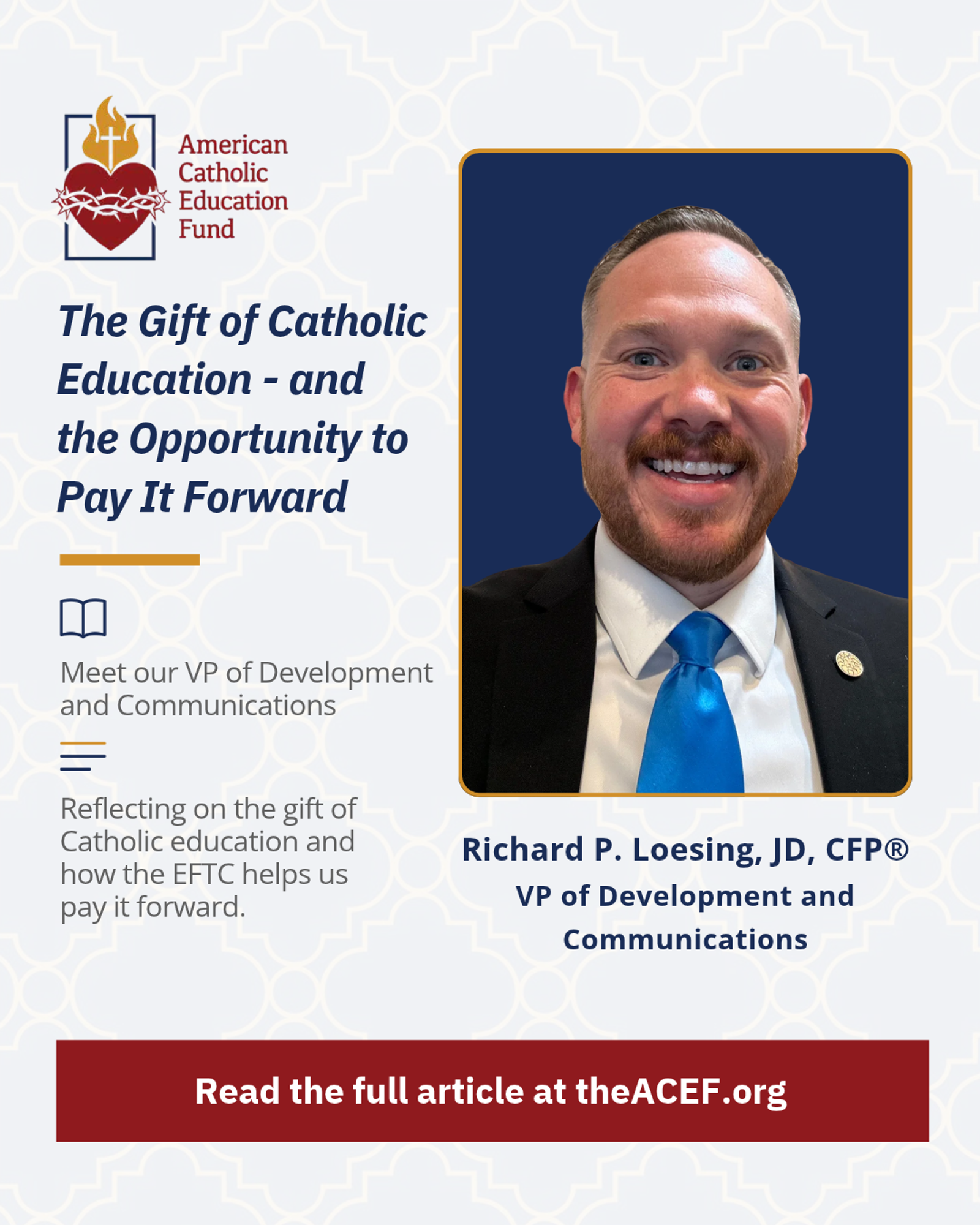
I am a product of Catholic education.
For 17 years, from kindergarten through my graduation from the University of Notre Dame, Catholic schools helped shape the person I am today. They gave me a strong academic foundation, but more importantly, helped form my faith, character, and sense of responsibility to others.
I also know I did not get there alone.
I grew up in a middle-class family and benefited from scholarships and financial aid throughout my entire educational journey. People willing to invest in students they might never meet opened doors for me, and their generosity continues to shape my life.
More Than an Education
When I look back on those years, some of my clearest memories have little to do with grades or exams.
I remember weekly Mass in grade school, opportunities for confession, and the lively Sunday evening Masses at my Notre Dame residence hall. I studied in an environment that encouraged me to deepen my relationship with Christ.
At the time, that seemed normal. Today, I recognize how extraordinary it was.
Catholic education does something distinctive: it treats intellectual growth and spiritual formation not as competing priorities, but as complementary parts of developing the human person. Faith undoubtedly has a place in the everyday questions, choices, friendships, and challenges of growing up.
As a husband and father, I appreciate that gift more than ever. And I want other children, including those whose families cannot easily afford tuition, to have the same opportunity.
A Generational Opportunity
That is why the Education Freedom Tax Credit (EFTC), launching January 1, 2027, immediately caught my attention.
The idea is simple: Individuals can give to an approved scholarship-granting organization and receive a dollar-for-dollar federal income tax credit of up to $1,700 a year, or $3,400 for married couples filing jointly if each spouse contributes. Unlike a deduction, which reduces taxable income, a credit directly reduces taxes owed. With sufficient federal income tax liability, a qualifying gift can be fully offset. Donors may live in any state, as long as they support an approved organization in a participating state.
The distinction matters. These are private gifts made by individuals, not scholarship checks written by the federal government. The tax credit simply makes it possible for people to support a child's education while potentially offsetting the entire contribution against federal taxes they would otherwise owe.
The EFTC can support a range of K–12 educational needs, including those of students in public, private, and religious schools. But its potential to expand access to Catholic education is something that speaks to me personally.
I think about parents who want a faith-centered education for their children but cannot make the numbers work. I think about Catholic schools striving to remain accessible while delivering excellent academics and authentic spiritual formation. And I think about children whose futures could change because someone decided to give.
The First Step Toward a Generous Life
What excites me just as much is what the EFTC could do for the people making those gifts.
As Catholics, we are called to lives of prayer, fasting, and almsgiving. Generosity is not supposed to be something we postpone until we have extra money, or something reserved for the wealthy. It is a habit of the heart, cultivated through action.
Yet philanthropy can feel out of reach, especially for young professionals and families balancing mortgages, childcare, and everyday expenses. Even those who care deeply about education may wonder whether they can afford to help.
The EFTC offers a remarkably accessible place to begin.
When a contribution can be offset by a tax credit, the financial barrier to giving becomes much smaller. Someone who has never considered making a substantial charitable gift might discover the satisfaction of helping a student attend school. A family might decide together which educational mission to support. Children might watch their parents give and begin to understand what generosity looks like.
The incentive may prompt the first gift. My hope is that it leads to a second, a third, and eventually a lifetime of giving—even without a tax incentive.
That, to me, is the deeper promise of this program: not only more scholarships, but more generous people.
Why I Joined ACEF
When I learned about the American Catholic Education Fund (ACEF), I saw a chance to bring these convictions together.
ACEF is unapologetically Catholic and exclusively supports Catholic schools. It works with dioceses across the country to help families access the opportunities created by the EFTC. It also works in full cooperation with the United States Conference of Catholic Bishops, which has reviewed and approved ACEF's founding documents, partnership agreements, and contracts.
Many worthy organizations will participate in this program. I wanted to be part of one whose Catholic identity is fundamental to its mission, and whose work could help make the education I received available to countless others.
Joining ACEF was more than an exciting professional opportunity. It was a chance to help pay forward a gift I spent 17 years receiving.
An Invitation to Give
In 2027, millions of Americans will have a new way to support children's education. I hope they will embrace it—not merely because the tax benefits are compelling, but because the students are worth investing in.
I know firsthand what Catholic education can give a young person. I also know what it means to receive an opportunity because someone else chose to be generous.
Now we have a chance to extend that same gift to the next generation.
I hope you will participate in the Education Freedom Tax Credit and consider doing so through ACEF. Together, we can make Catholic education more accessible—and help cultivate a culture of generosity that lasts long after the first scholarship is awarded.